
Further Education Support & Information
college & university
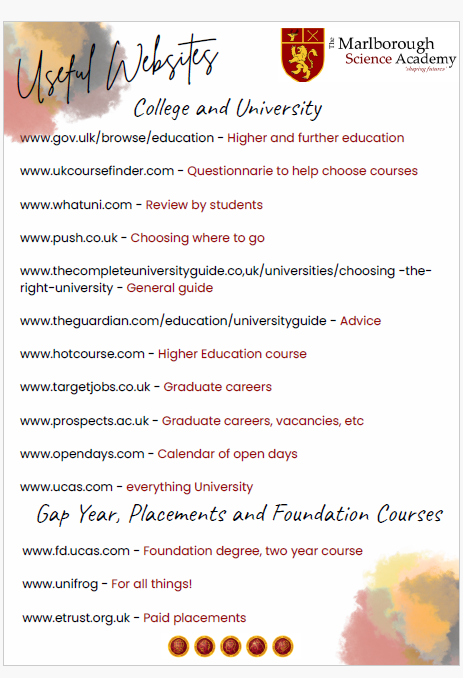
A vast majority of our students go to university after completing their A level studies. A growing number of students access high level apprenticeships whilst others decide to join the work force. For further information on College and University choices, please see useful websites list below.
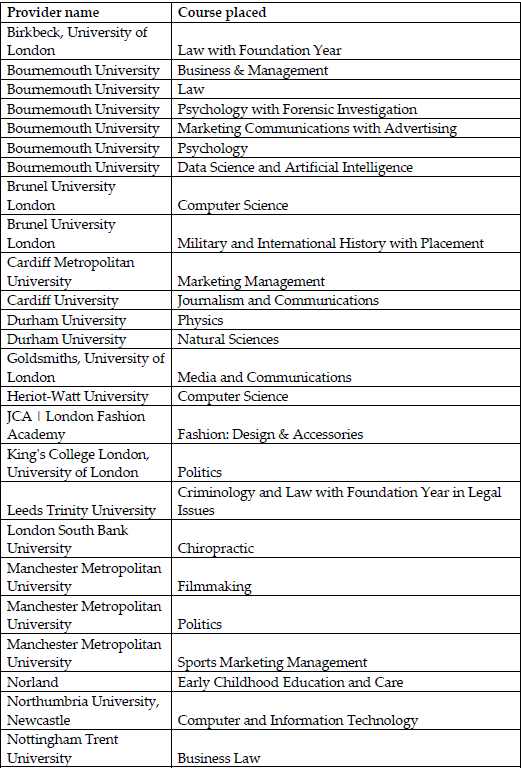
A sample of university courses and destinations is below:
Oxbridge application guide 2026-7
Oxbridge Application Guide 2026–27
A Step-by-Step Timeline for Students Applying to Oxford or Cambridge
Applying to Oxbridge is different from applying to other universities. The process starts earlier, involves extra preparation, and requires students to demonstrate genuine academic curiosity beyond the classroom.
This guide takes you through the process month by month.
Step 1: Explore Your Subject
Before Year 12 Ends (Spring–Summer of Year 12)
What to do
- Read books beyond your A Level specification.
- Watch university lectures online.
- Listen to subject-specific podcasts.
- Attend university outreach events.
- Complete MOOCs (online courses).
- Check your subject with the university, they may offer courses for you to attend
Why?
Oxbridge tutors want students who love their subject, not just students with good grades.
Keep an Academic Journal
Record:
- Books you've read
- Articles you've found interesting
- Documentaries watched
- Lectures attended
- Ideas and questions that interested you
This will provide excellent material for your personal statement and interview.
Step 2: Research Colleges
Oxford and Cambridge are collegiate universities.
You apply to:
- The university
- A specific college (or make an open application)
Research:
- Location
- Accommodation
- Facilities
- Subject strengths
- College atmosphere
Remember, the course matters far more than the college.
Step 3: Check Entry Requirements
June–July (End of Year 12)
Look carefully at:
Academic Requirements
Most courses require AAA–AAA. However, some courses may have subject-specific requirements, for example:
- Medicine requires Chemistry
- Engineering often requires Maths and Physics
Check requirements carefully on the official university websites.
Step 4: Find Out Whether Your Course Requires an Admissions Test
Many Oxbridge courses require additional assessments.
Examples include:
- Law
- Medicine
- Engineering
- Mathematics
- Physics
- Economics
- History
Make a note of:
- Test name
- Registration deadline
- Test date
Missing registration deadlines can end an application.
Step 5: Build Super-Curricular Knowledge
Summer Holidays (July–August)
This is one of the most important stages.
Super-Curricular Activities
These are activities directly related to your chosen subject.
Examples:
Geography
- Read academic geography books
- Follow environmental news
- Watch Royal Geographical Society lectures
Physics
- Read popular science books
- Attempt challenging problems
- Watch university lectures
Aim for:
- 3–5 books/articles
- Several lectures/podcasts
- Evidence of reflection
Step 6: Draft Your Personal Statement
Focus on 80% Academic interest and 20% Other activities
Include:
- What sparked your interest
- What you've explored independently
- What you've learnt
- Questions you've developed
Avoid:
- Long lists
- Generic statements
- Excessive discussion of hobbies
Step 7: Finalise Application
September (Year 13)
Work with teachers to:
- Complete UCAS application
- Refine personal statement
- Confirm predicted grades
Step 8: Register for Admissions Tests
June-August
Deadlines are often in September. Check these carefully. You need to check what additional tests there are, how to book them and start preparing for them. The earlier you can do this, the better. Late registration is usually impossible.
Step 9: Submit UCAS Application
Important Deadline 15 October 2026
This is earlier than most university applications. Do not leave submission until the last minute.
Step 10: Sit Admissions Tests
Many tests take place during October. However, you will need to ensure you know exactly when these are.
Preparation should include:
- Past papers
- Timed practice
- Reviewing mark schemes
- Analysing mistakes
Step 11: Prepare for Interviews
November
If shortlisted, interview invitations usually arrive during November. Do not panic! Interviews are not designed to catch you out. Tutors want to see how you think.
Interview Preparation Guide
What Tutors Are Looking For
They want students who:
✓ Think logically
✓ Respond to new ideas
✓ Explain their reasoning
✓ Show curiosity
✓ Accept challenge
✓ Enjoy learning
They are NOT looking for:
- Perfect answers
- Memorised responses
- Encyclopaedic knowledge
How to Prepare
Read Around Your Subject
Know:
- What you've read
- Why you found it interesting
- What questions it raised
You should be able to discuss every book or article mentioned in your personal statement.
Practise Thinking Aloud
Interviewers need to hear your reasoning. So, instead of saying: "The answer is X." consider your reasoning and frame to say, "My first thought is X because... However, if I consider Y, that might change my answer..."
Practise Being Challenged
Interviewers may say: "What if you're wrong?" or “Can you think of another explanation?" This is not criticism. They are testing flexibility of thought.
Use the "Think–Explain–Evaluate" Method
Think: What's your initial answer?
Explain: Why do you think that?
Evaluate: What are the limitations?
Example Interview Questions
Geography
- Why do cities grow?
- What causes migration?
- Is climate change mainly a human problem?
Medicine
- Why do you want to be a doctor?
- What ethical issues face medicine?
- Discuss a recent medical development
Physics
- What is infinity?
- How would you measure the height of a building using a barometer?
- Why do scientists use models?
Step 12: Attend Interviews
December
Before the Interview
- Sleep well.
- Arrive early.
- Dress comfortably and professionally.
- Bring any requested documents.
During the Interview
Do:
✓ Think aloud
✓ Ask for clarification if needed
✓ Take time to think
✓ Stay calm
✓ Engage in discussion
Don't:
✗ Panic if you don't know the answer
✗ Memorise speeches
✗ Rush
✗ Give up when challenged
Step 13: Decisions Released
January
Possible outcomes:
Offer: Congratulations! You will receive conditions based on A Level grades.
Pooling (Cambridge): Your application may be considered by another college.This is normal and often positive.
Unsuccessful: Remember: Thousands of exceptional students are unsuccessful each year. Many go on to thrive at other top universities.
Oxbridge Success Checklist
By September
□ Read at least 3–5 subject-related books
□ Keep an academic journal
□ Attend lectures or outreach events
□ Research colleges
□ Draft personal statement
□ Prepare for admissions tests
By October
□ Submit UCAS application
□ Sit admissions tests
By November
□ Complete multiple mock interviews
□ Review personal statement
□ Practise thinking aloud
□ Read current developments in your subject
Final Advice
The strongest Oxbridge applicants are not necessarily the smartest students. They are the students who can demonstrate:
Curiosity + Academic Passion + Independent Thinking + Resilience
Focus less on trying to impress tutors and more on showing them how your mind works. That is what the interview is really designed to reveal.
reading list - suggestions by subject
These texts are not your core texts, nor are they your guided secondary reading. Rather, they are suggestions of what else you could dip your toe into to support your studies and understanding of your subjects.
It is by no means an exhaustive list; it should give you somewhere to start when faced with a whole world of further reading possibilities!
Happy reading!
Fiction we can all enjoy
To Kill A Mockingbird by Harper Lee
1984 by George Orwell
Wuthering Heights by Emily Bronte
In Memorandum by Alice Winn
Birdsong by Sebastian Faulks
The Haunting of Hill House by Shirley Jackson
Tokyo Express by Seicho Matsumoto
Pride and Prejudice by Jane Austin
Birdsong by Sebastian Faulks
Crime and Punishment by Fyodor Dostoevsky
Non-Fiction we can all learn from
Sapiens: A brief History of Humankind by Yuval Noah Harari
Educated by Tara Westover
Why we Sleep by Matthew Walker
The Power of Habit by Charles Duhigg
Start with Why by Simon Sinek
A Short History of Nearly Everything by Bill Bryson
Down and Out in London and Paris by H. G Wells
Subject Specific Readling List
Art
Ways of Seeing by John Berger
Big Magic: Creative Living Beyond Fear by Elizabeth Gilbert
Biology
The Gene by Siddhartha Mukherjee
The Selfish Gene by Richard Dawkins
Business Studies
Lean In by Sheryl Sandberg
The Undercover Economist by Tim Harford
Chemistry
Stuff Matters by Mark Miodownik
The Disappearing Spoon by Sam Keen
Classics
Theogony by Hesiod
Mythos / Heroes/ Troy / Odyssey by Stephen Fry
The Penelopiad by Margaret Atwood
A Thousand Ships by Natalie Haynes
Circe by Madeline Miller
The Iliad by Homer
The Cicero Trilogy (Imperium, Lustrum, Dictator) by Robert Harris
Rubicon by Tom Holland
SPQR by Mary Beard
Computer Science
The Code Book by Simon Singh
The Master Algorithm by Pedro Domingos
Steve Jobs by Walter Isaacson
Drama
An Actor Prepares by Constantin Stanislavski
We Play Ourselves by Jen Silverman
National Theatre Backstage Guide - Auditioning by Sam Stevenson
National Theatre Backstage Guide - Acting by Lucian Msamati
Getting Into Drama School: The Compact Guide by Nick Moseley
English Literature
The Bell Jar by Sylvia Plath
One Hundred Years of Solitude by Gabriel García Márquez
Perfume by Patrick Süskind
I Capture The Castle by Dodie Smith
We Have Always Lived In The Castle by Shirley Jackson
In Cold Blood by Truman Capote
Sharp Objects by Gillian Flynn
Practical Magic by Alice Hoffman
The Handmaid’s Tale by Margaret Atwood.
The Quiet American by Graham Green.
The Glass Castle by Jeanette Walls
Geography
There is no Planet B by Mike Berners-Lee
Prisoners of Geography by Tim Marshall
Disaster by Choice: How our actions turn natural hazards into catastrophes (Hardcover) by Ilan Kelman
The Almighty Dollar: Follow the Incredible Journey of a Single Dollar to See How the Global Economy Really Works (Hardcover) by Dharshini David
Graphics
A Designer's Art by Paul Rand
The Passport by Saul Steinberg
History
Postwar by Tony Judt
Dominion by Tom Holland
The Houses of History by Green & Troup
The Making of the English Working Class by E.P. Thompson
Normandy 44 by Tom Holland
Catastrophe by Max Hastings
Churchill by Andrew Roberts
The Making of Modern Britain by Andrew Marr
A History of Modern Britain by Andrew Marr
Long Walk to Freedom by Nelson Mandela
The Mind of South Africa by Allistair sparks
Maths
The Music of Prime Numbers by Marcus du Sautoy
Fermat’s Last Theorem by Simon Singh
Media Studies
Mythologies by Roland Barthes
5 The Media Student’s Book
Music
A History of Western Music by Burkholder, Grout & Palisca
This Is Your Brain on Music by Daniel Levitin
How Music Works by David Byrne
Photography
1001 Photographs You Must See Before You Die by Paul Lowe
On Photography by Susan Sontag
Physics
Seven Brief Lessons on Physics by Carlo Rovelli
A Brief History of Time by Stephen Hawking
Politics
How Democracy Dies by Levitsky and Ziblatt
Why Nations Fail by Acemoglu and Robinson
The Political Animal: An Anatomy by Jeremy Paxman
Prisoners of Geography by Tim Marshall
The Establishment: And How They Get Away With It by Owen Jones
The Righteous Mind by Jonathan Haidt
Product Design
The Design of Everyday Things by Don Norman
Hooked by Nir Eyal
Psychology
The Lucifer Effect by Philip Zimbardo
Behave by Robert Sapolsky
Sociology
The Sociological Imagination by C. Wright Mills
Modernity and Self Identity by Anthony Gidden
Sport
The Sports Gene by David Epstein
The Champions Mind by Jim Afremow